

DBT Resource · Starting Early
You already know
something is coming.
You can feel it building. The shift in your mood, the tightness in your chest, the moment that is quietly heading your way. You have been here before. And you know how it goes when you are not ready for it.
Get the workbook — $29.99Digital download · Instant access · Pay once, keep it
The hard part isn't the emotion.
It's being caught off guard by it.
Most of us know, on some level, what our patterns look like. We know which situations tend to escalate. We know the early signs. We know the mornings that are harder than others. And yet, when the moment arrives, it feels like the first time. Because we never had a plan ready.
That is not a character flaw. It is a gap in preparation. And it is exactly what this workbook was built to close.
"You do not have to be in crisis to use these skills. The whole point is to practise them before you need them most."
Starting Early is built around one idea: the best time to prepare for an emotional moment is before it happens. Not in the middle of it — when your thinking brain has gone offline and your nervous system is running the show. Before. While you are calm enough to choose.
This is not about becoming someone who never struggles. It is about having real tools in your hands when the struggle shows up — so you are not starting from zero every time.
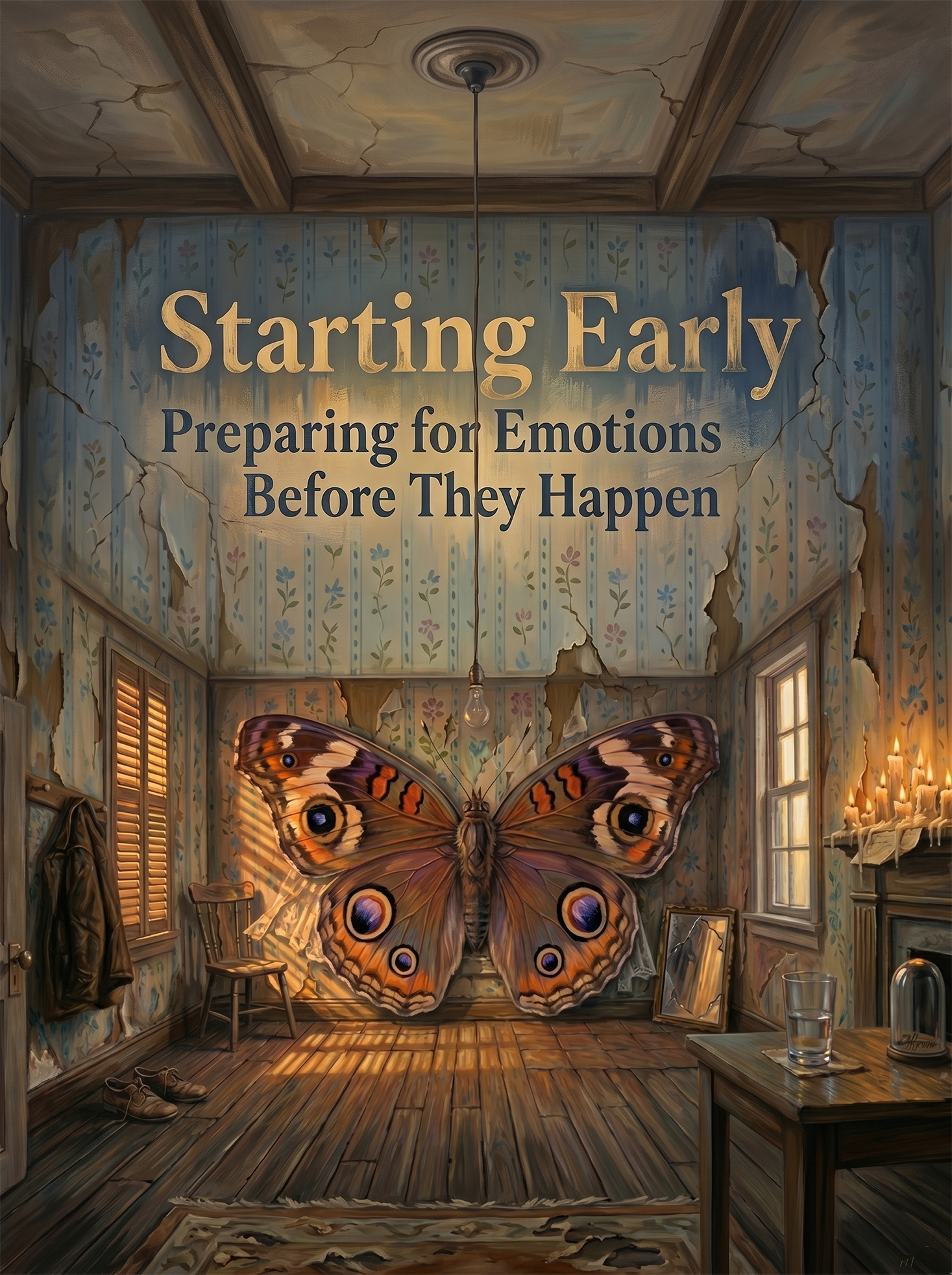
Starting Early
Preparing for Emotions Before They Happen
A self-paced DBT workbook for anyone navigating intense emotional cycles. Five skills, plain language, real exercises — written from lived experience, not a clinical office. You work through it at your own pace, in your own time, in your own space.
Five DBT skills. Each one explained,
practised, and yours to keep.
Skill 01
Wise Mind
Learn to find the still point between emotion and logic — the grounded place that is always there, even when you cannot feel it. Exercises help you recognize which state of mind is running things right now.
Skill 02
Coping Ahead
Identify the situations that tend to go sideways. Decide now how you want to respond. Rehearse it in writing before the emotion is high enough to hijack your judgment. Athletes do this. You can too.
Skill 03
TIP / TIPP
Four body-based skills that bring down intense emotional arousal fast — using temperature, movement, breath, and muscle relaxation. When the thinking brain is offline, these work from the bottom up.
Skill 04
Radical Acceptance
Not approval. Not giving up. Just stopping the second layer of suffering that comes from fighting what has already happened. Step-by-step guidance on how to practise this — including when it does not come easily.
Skill 05
DEAR MAN
A structured way to ask for what you need, say no, or hold your position in a hard conversation — while keeping the relationship intact. Especially useful when your emotional state is trying to run the interaction.
Throughout
Space to write.
Every skill includes guided reflection prompts and writing space. You are not just reading about this — you are doing it. Each section builds on the last. No prior experience with DBT required.
This workbook was written for people
who want tools.
This is for you if —
- You live with intense emotional cycles or a mood condition
- You have been through hard times and want to be more prepared
- You are in recovery and looking for practical daily tools
- You want DBT skills without the waitlist or the clinical setting
- You are supporting someone who could use this kind of resource
- You work at your own pace and want something you can return to
- You are tired of vague advice and want actual exercises
This is not —
- A replacement for therapy or clinical care
- A crisis intervention tool
- Written for clinicians or from a clinical perspective
- Full of jargon you need a degree to understand
- A quick fix or a one-and-done read
- Designed to tell you what is wrong with you
There is a lot of mental health content out there.
Here is why this is not that.
It comes from inside the experience.
Stef is not a therapist writing about what the research says. She is someone living with bipolar disorder, trained as a senior peer mentor, who built these tools for herself and her peers first. That changes what goes in — and what gets left out.
Plain language. No clinical distance.
DBT is genuinely useful — but a lot of the materials that teach it feel like they were written for intake forms. This workbook explains each skill the way a peer would, in a conversation. Clear, honest, and without the wall of terminology.
Built to be used, not just read.
Every section has writing prompts, reflection space, and exercises you can complete right in the workbook. You are building actual plans and practising actual skills — not just learning that these skills exist.

Written by someone
who has been there.
Stef is a certified senior peer mentor, trained at the McGill University Health Centre in Montreal, with over three years of peer mentorship experience. She lives with bipolar disorder. She built these tools from that place — not as a clinician looking in, but as someone navigating the same road.
upsanddowns.xyz exists because Stef could not always find resources that felt suitable for her needs. So she made them.
Questions you might have.
"I've tried workbooks before and never finished them."
This one is designed so you do not have to finish it in order. You can go directly to the skill that feels most relevant right now. There is no right order, no timeline, and no test at the end. Come back to it whenever you need it.
"I don't know anything about DBT."
You do not need to. Each skill is explained from the ground up, in plain language. The workbook assumes no prior knowledge — just a willingness to try something.
"I'm already in therapy. Do I need this?"
A lot of people use this alongside therapy, not instead of it. Your clinician is part of your team. This workbook is something you can work through between sessions, on your own terms, at your own pace.
"Is it really worth $29.99?"
It is a one-time purchase, a PDF you keep, and something you can return to as many times as you need. If one skill from this workbook changes how you handle one hard moment — that is already worth more than the price.
The next hard moment is coming.
You can be ready for it.
Starting Early gives you five real skills and a plan for using them — before you need them. Written by a peer. Built for real life.